

Rare hematological diseases, although individually uncommon, collectively affect millions of people worldwide. They share major challenges such as delayed diagnosis, limited access to treatments, and the need for effective patient communication.
Addressing these issues requires a multidisciplinary and international network committed to building a shared framework for action. The rapid evolution of therapies demands continuous education for healthcare professionals.
This event is part of the GARDEN Network CME Webinar Series focusing on key areas of recent progress:
Hemophilia: Updates on real-world evidence and international consensus on prophylaxis and treatment to ensure consistent standards of care;
Thalassemia and MDS: Insights into the real-life use of luspatercept and its role in improving outcomes and safety across patient populations;
● PK Deficiency, Thalassemia, and SCD: A comparative view on mitapivat and etavopivat as targeted therapies across different rare red cell disorders;
● TTP: Challenges in real-life diagnosis and management of this hematological emergency;
● PNH: Advances in available treatments and ongoing barriers linked to cost and access;
● GENE THERAPY: Real-world evidence from European experience, marking its arrival at the patient’s bedside;
● AI: Exploring new AI tools to enhance clinical data collection and support future clinical trials in rare hematological diseases.
Artificial Intelligence (AI) is becoming an essential tool in medical research, offering unprecedented opportunities in data management, pattern recognition, and the development of prognostic models.
In the field of rare hematological diseases — where small patient populations and fragmented data pose significant challenges — AI can support clinicians and researchers in improving diagnosis, refining prognostic factors, and enhancing patient outcomes. This educational event will bring together international experts to present the current state of AI applications in hematology, share real-world experiences, and discuss the ethical and practical aspects of integrating AI into clinical research. A specific focus will be devoted to the role of AI in advancing a new vision of thalassemia as a benign disorder of hematopoietic stem cells (HSCs). Through AI-assisted literature review and the creation of virtual patient cohorts within the GARDEN Network, it will be possible to strengthen the scientific evidence supporting this concept and to facilitate the design of more robust pharmacological trials. This methodology — already successfully applied to myelodysplastic syndromes — can be extended to other rare hematological diseases, promoting a unified data-driven research model. The ultimate goal of the webinar is to reach a consensus agreement among participants and to lay the foundation for an International GARDEN Consortium dedicated to conducting meta-analyses, building AI supported virtual cohorts, and driving pharmacological innovation in rare hematological disorders.
FAD LIVE!
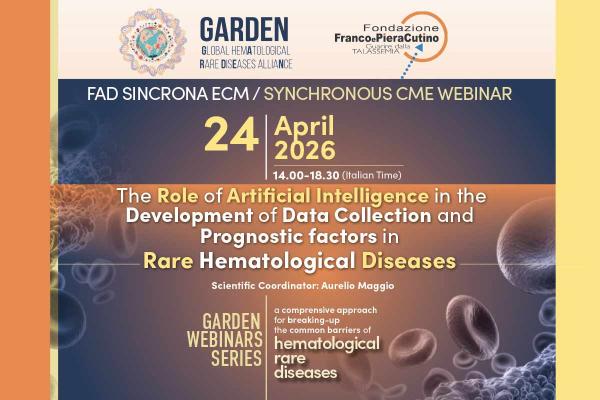
THE ROLE OF ARTIFICIAL INTELLIGENCE IN THE DEVELOPMENT OF DATA COLLECTION AND PROGNOSTIC FACTORS IN RARE HEMATOLOGICAL DISEASES
FAD
AVVISO IMPORTANTE
24/04/2026
WEBINAR DIRETTA ZOOM dalle ore 14.00
Al termine, ogni partecipante, dovrà sostenere un test di valutazione e compilare il modulo di qualità attraverso la piattaforma
Test e modulo si potranno compilare entro il 27/04/2026
- numero massimo tentativi: 5
- soglia superamento: 75% delle risposte estatte
È OBBLIGATORIA LA PRESENZA PER TUTTA LA DURATA DELLA TRASMISSIONE PER PROCEDERE ALLA PARTE ECM PREVISTA
LA VISIONE DELLA REGISTRAZIONE NON SOSTITUISCE L'OBBLIGATORIETÀ DI PRESENZA ALLA DIRETTA
Presentazione
Programma
24 aprile 2026
DIRETTA WEBINAR dalle ore 14.00
È OBBLIGATORIA LA PRESENZA PER TUTTA LA DURATA DELLA TRASMISSIONE PER PROCEDERE ALLA PARTE ECM PREVISTA
LA VISIONE DELLA REGISTRAZIONE NON SOSTITUISCE L'OBBLIGATORIETÀ DI PRESENZA ALLA DIRETTA
Al termine ogni partecipante dovrà sostenere un test di valutazione e compilare il modulo di qualità percepita attraverso la piattaforma
PASSAGGIO OBBLIGATORIO PER CONSEGUIRE I CREDITI ECM PREVISTI
Test e modulo si dovranno compilare entro il 27/04/2026
Attenzione:
- numero massimo di tentativi a diposizione: 5
- soglia di superamento: 75% delle risposte corrette
IL PROGRAMMA È DISPONIBILE CLICCANDO Locandina IN ALTO PAGINA O Allegati A FONDO PAGINA
Informazioni
Obiettivo formativo
3 - Documentazione clinica. Percorsi clinico-assistenziali diagnostici e riabilitativi, profili di assistenza - profili di cura
Mezzi tecnologici necessari
Per la fruizione della diretta sarà necessario installare il programma gratuito ZOOM, Potete effettuare il download del programma, e le relative istruzioni di installazione su https://zoom.us/download
Procedure di valutazione
Questionario a risposta multipla e doppia randomizzazione da compilare tramite la piattaforma entro il 27/04/2026
Attenzione:
- numero massimo di tentativi a diposizione: 5
- soglia di superamento: 75% delle risposte corrette
Responsabili
Responsabile scientifico
-
 Aurelio MaggioPresident Foundation Franco e Piera Cutino Member of EHA Former President of SITE
Relatore
-
 Saverio D'AmicoTeam Leader & Senior Data Scientist (Humanitas Research Hospital)
 -
 Mohammed Fuad EssaKing Abdullah Specialist Children Hospital
 -
 Saghi GhaffariProfessor: Cell, Developmental and Regenerative Biology and Medicine
 -
 Olivier Robert Paul HermineProfessor of Hematology at Paris V-Rene Descartes University (Paris, France)
 -
 Alessandro LucchesiDirigente Medico ematologo - IRST IRCCS di Meldola (Forlì-Cesena)
 -
 Raffaella OrigaProfessore Associato di Pediatria, Università di Cagliari, Dipartimento di Scienze Mediche e Sanità Pubblica
 -
 Schott Alan PeslakPhysician-scientist at the University of Pennsylvania
 -
 Duncan R. SmithProfessor at Institute of Molecular Biosciences, Mahidol University (Thailandia)
Moderatore
-
 Giacomo DiedenhofenDirigente Medico - Specialista in Statistica Sanitaria e Biometria Unità Aziendale di Sorveglianza Epidemiologica
 -
Aurelio MaggioPresident Foundation Franco e Piera Cutino Member of EHA Former President of SITE
-
 Stefano RivellaProf of Pediatrics at the Children’s Hospital of Philadelphia and University of Pennsylvania
 -
 Alok SrivastavaProfessor & Head, Haematology Research Unit St. Johns Research Institute - Bengaluru (India)